Wednesday, October 6, 2010

Safety of Nuclear Power Reactors

Safety First!


  1. From the outset, there has been a strong awareness of the potential hazard of both nuclear criticality and release of radioactive materials.
  2. There have been two major reactor accidents in the history of civil nuclear power - Three Mile Island and Chernobyl. One was contained without harm to anyone and the other involved an intense fire without provision for containment.
  3. These are the only major accidents to have occurred in some 14,000 cumulative reactor-years of commercial operation in 32 countries.
  4. The risks from western nuclear power plants, in terms of the consequences of an accident or terrorist attack, are minimal compared with other commonly accepted risks. Nuclear power plants are very robust.
  5. Safety is achieved through "defence in depth".

Context

In relation to nuclear power, Safety is closely linked with Security, and in the nuclear field also with Safeguards. Some distinctions:
Safety focuses on unintended conditions or events leading to radiological releases from authorised activities. It relates mainly to intrinsic problems or hazards.

Security focuses on the intentional misuse of nuclear or other radioactive materials by non-state elements to cause harm. It relates mainly to external threats to materials or facilities.

Safeguards focus on restraining activities by states that could lead to acquisition of nuclear weapons. It concerns mainly materials and equipment in relation to rogue governments.

In the 1950s attention turned to harnessing the power of the atom in a controlled way, as demonstrated at Chicago in 1942 and subsequently for military research, and applying the steady heat yield to generate electricity. This naturally gave rise to concerns about accidents and their possible effects. In particular the scenario of loss of cooling which resulted in melting of the nuclear reactor core motivated studies on both the physical and chemical possibilities and the biological effects of any dispersed radioactivity.

Those responsible for nuclear power technology in the west devoted extraordinary effort to ensuring that a meltdown of the reactor core would not take place, since it was assumed that a meltdown of the core would create a major public hazard, and if uncontained, a tragic accident with likely fatalities.

In avoiding such accidents the industry has been outstandingly successful. In over 14,000 cumulative reactor-years of commercial operation in 32 countries, there have been only two major accidents to nuclear power plants - Three Mile Island and Chernobyl, the latter being of little relevance outside the old Soviet bloc.

It was not until the late 1970s that detailed analyses and large-scale testing, followed by the 1979 meltdown of the Three Mile Island reactor, began to make clear that even the worst possible accident in a conventional western nuclear power plant or its fuel could not cause dramatic public harm. The industry still works hard to minimize the probability of a meltdown accident, but it is now clear that no-one need fear a potential public health catastrophe.

The decades-long test and analysis program showed that less radioactivity escapes from molten fuel than initially assumed, and that this radioactive material is not readily mobilized beyond the immediate internal structure. Thus, even if the containment structure that surrounds all modern nuclear plants were ruptured, it would still be highly effective in preventing escape of radioactivity.

It is the laws of physics and the properties of materials that preclude disaster, not the required actions by safety equipment or personnel. In fact, licensing approval now requires that the effects of any core-melt accident must be confined to the plant itself, without the need to evacuate nearby residents.

The two significant accidents in the 50-year history of civil nuclear power generation are:

  • Three Mile Island (USA 1979) where the reactor was severely damaged but radiation was contained and there were no adverse health or environmental consequences
  • Chernobyl (Ukraine 1986) where the destruction of the reactor by steam explosion and fire killed 31 people and had significant health and environmental consequences. The death toll has since increased to about 56.

A table showing all reactor accidents, and a table listing some energy-related accidents with multiple fatalities are appended.

These two significant accidents occurred during more than 14,000 reactor-years of civil operation. Of all the accidents and incidents, only the Chernobyl accident resulted in radiation doses to the public greater than those resulting from the exposure to natural sources. Other incidents (and one 'accident') have been completely confined to the plant.

Apart from Chernobyl, no nuclear workers or members of the public have ever died as a result of exposure to radiation due to a commercial nuclear reactor incident. Most of the serious radiological injuries and deaths that occur each year (2-4 deaths and many more exposures above regulatory limits) are the result of large uncontrolled radiation sources, such as abandoned medical or industrial equipment. (There have also been a number of accidents in experimental reactors and in one military plutonium-producing pile - at Windscale, UK, in 1957, but none of these resulted in loss of life outside the actual plant, or long-term environmental contamination.)

Cumulative Reactor Years

It should be emphasised that a commercial-type power reactor simply cannot under any circumstances explode like a nuclear bomb.

The International Atomic Energy Agency (IAEA) was set up by the United Nations in 1957. One of its functions was to act as an auditor of world nuclear safety. It prescribes safety procedures and the reporting of even minor incidents. Its role has been strengthened since 1996 (see later section). Every country which operates nuclear power plants has a nuclear safety inspectorate and all of these work closely with the IAEA.

While nuclear power plants are designed to be safe in their operation and safe in the event of any malfunction or accident, no industrial activity can be represented as entirely risk-free. However, a nuclear accident in a western-type reactor is now understood to have severe financial consequences for the owner but will give rise to minimal off-site consequences.

Achieving safety: the record so far

Operational safety is a prime concern for those working in nuclear plants. Radiation doses are controlled by the use of remote handling equipment for many operations in the core of the reactor. Other controls include physical shielding and limiting the time workers spend in areas with significant radiation levels. These are supported by continuous monitoring of individual doses and of the work environment to ensure very low radiation exposure compared with other industries.

Concerning possible accidents, up to the early 1970s, some extreme assumptions were made about the possible chain of consequences. These gave rise to a genre of dramatic fiction (eg The China Syndrome) in the public domain and also some solid conservative engineering including containment structures (at least in Western reactor designs) in the industry itself. Licensing regulations were framed accordingly.

One mandated safety indicator is the calculated probable frequency of degraded core or core melt accidents. The US Nuclear Regulatory Commission (NRC) specifies that reactor designs must meet a 1 in 10,000 year core damage frequency, but modern designs exceed this. US utility requirements are 1 in 100,000 years, the best currently operating plants are about 1 in 1 million and those likely to be built in the next decade are almost 1 in 10 million.

Even months after the Three Mile Island accident in 1979 it was assumed that there had been no core melt because there were no indications of severe radioactive release even inside the containment. It turned out that in fact about half the core had melted. This remains the only core melt in a reactor conforming to NRC safety criteria, and the effects were contained as designed, without radiological harm to anyone.*

* About this time there was alarmist talk of the so-called "China Syndrome", a scenario where the core of such a reactor would melt, and due to continual heat generation, melt its way through the reactor pressure vessel and concrete foundations to keep going until it reached China on the other side of the globe! The TMI accident proved the extent of truth in the proposition, and the molten core material got exactly 15 mm of the way to China as it froze on the bottom of the reactor pressure vessel.

However apart from this accident and the Chernobyl disaster there have been about ten core melt accidents - mostly in military or experimental reactors lists most of them. None resulted in any hazard outside the plant from the core melting, though in one case there was significant radiation release due to burning fuel in hot graphite (similar to Chernobyl but smaller scale).

Regulatory requirements today are that the effects of any core-melt accident must be confined to the plant itself, without the need to evacuate nearby residents.

The main safety concern has always been the possibility of an uncontrolled release of radioactive material, leading to contamination and consequent radiation exposure off-site. . Earlier assumptions were that this would be likely in the event of a major loss of cooling accident (LOCA) which resulted in a core melt. Experience has proved otherwise in any circumstances relevant to Western reactor designs. In the light of better understanding of the physics and chemistry of material in a reactor core under extreme conditions it became evident that even a severe core melt coupled with breach of containment could not in fact create a major radiological disaster from any Western reactor design. Studies of the post-accident situation at Three Mile Island (where there was no breach of containment) supported this.

An OECD/NEA report in 2010 pointed out that the theoretically-calculated frequency for a large release of radioactivity from a severe nuclear power plant accident has reduced by a factor of 1600 between the early Generation I reactors as originally built and the Generation III/III+ plants being built today. Earlier designs however have been progressively upgraded through their operating lives.

It has long been asserted that nuclear reactor accidents are the epitome of low-probability but high-consequence risks. Understandably, with this in mind, some people were disinclined to accept the risk, however low the probability. However, the physics and chemistry of a reactor core, coupled with but not wholly depending on the engineering, mean that the consequences of an accident are likely in fact be much less severe than those from other industrial and energy sources. Experience bears this out.

At Chernobyl the kind of reactor and its burning contents which dispersed radionuclides far and wide tragically meant that the results were severe. This once and for all vindicated the desirability of designing with inherent safety supplemented by robust secondary safety provisions and avoiding that kind of reactor design. However, the problem here was not burning graphite as popularly quoted. The graphite was certainly incandescent as a result of fuel decay heat - sometimes over 1000°C - and some of it oxidised to carbon monoxide which burned along with the fuel cladding.

Mention should be made of the accident to the US Fermi-1 prototype fast breeder reactor near Detroit in 1966. Due to a blockage in coolant flow, some of the fuel melted. However no radiation was released off-site and no-one was injured. The reactor was repaired and restarted but closed down in 1972.

The use of nuclear energy for electricity generation can be considered extremely safe. Every year several thousand people die in coal mines to provide this widely used fuel for electricity. There are also significant health and environmental effects arising from fossil fuel use.

In passing, it is relevant to note that the safety record of the US nuclear navy from 1955 on is excellent, this being attributed to a high level of standardisation in over one hundred naval power plants and in their maintenance, and the high quality of the Navy's training program. Until the 1980s, the Soviet naval record stood in marked contrast.

Achieving optimum nuclear safety

To achieve optimum safety, nuclear plants in the western world operate using a 'defence-in-depth' approach, with multiple safety systems supplementing the natural features of the reactor core. Key aspects of the approach are:

  • high-quality design & construction,
  • equipment which prevents operational disturbances or human failures and errors developing into problems,
  • comprehensive monitoring and regular testing to detect equipment or operator failures,
  • redundant and diverse systems to control damage to the fuel and prevent significant radioactive releases,
  • provision to confine the effects of severe fuel damage (or any other problem) to the plant itself.

These can be summed up as: Prevention, Monitoring, and Action (to mitigate consequences of failures).

The safety provisions include a series of physical barriers between the radioactive reactor core and the environment, the provision of multiple safety systems, each with backup and designed to accommodate human error. Safety systems account for about one quarter of the capital cost of such reactors.

The barriers in a typical plant are: the fuel is in the form of solid ceramic (UO2) pellets, and radioactive fission products remain largely bound inside these pellets as the fuel is burned. The pellets are packed inside sealed zirconium alloy tubes to form fuel rods. These are confined inside a large steel pressure vessel with walls up to 30 cm thick - the associated primary water cooling pipework is also substantial. All this, in turn, is enclosed inside a robust reinforced concrete containment structure with walls at least one metre thick. This amounts to three significant barriers around the fuel, which itself is stable.

These barriers are monitored continually. The fuel cladding is monitored by measuring the amount of radioactivity in the cooling water. The high pressure cooling system is monitored by the leak rate of water, and the containment structure by periodically measuring the leak rate of air at about five times atmospheric pressure.

Looked at functionally, the three basic safety functions in a nuclear reactor are: to control reactivity, to cool the fuel and to contain radioactive substances.

The main safety features of most reactors are inherent - negative temperature coefficient and negative void coefficient. The first means that beyond an optimal level, as the temperature increases the efficiency of the reaction decreases (this in fact is used to control power levels in some new designs). The second means that if any steam has formed in the cooling water there is a decrease in moderating effect so that fewer neutrons are able to cause fission and the reaction slows down automatically.

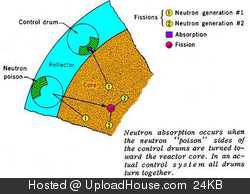
Beyond the control rods which are inserted to absorb neutrons and regulate the fission process, the main engineered safety provisions are the back-up emergency core cooling system (ECCS) to remove excess heat (though it is more to prevent damage to the plant than for public safety) and the containment.

Traditional reactor safety systems are 'active' in the sense that they involve electrical or mechanical operation on command. Some engineered systems operate passively, eg pressure relief valves. Both require parallel redundant systems. Inherent or full passive safety design depends only on physical phenomena such as convection, gravity or resistance to high temperatures, not on functioning of engineered components. All reactors have some elements of inherent safety as mentioned above, but in some recent designs the passive or inherent features substitute for active systems in cooling etc.

The basis of design assumes a threat where due to accident or malign intent (eg terrorism) there is core melting and a breach of containment. This double possibility has been well studied and provides the basis of exclusion zones and contingency plans. Apparently during the Cold War neither Russia nor the USA targeted the other's nuclear power plants because the likely damage would be modest.

Nuclear power plants are designed with sensors to shut them down automatically in an earthquake, and this is a vital consideration in many parts of the world.

The Three Mile Island accident in 1979

demonstrated the importance of the inherent safety features. Despite the fact that about half of the reactor core melted, radionuclides released from the melted fuel mostly plated out on the inside of the plant or dissolved in condensing steam. The containment building which housed the reactor further prevented any significant release of radioactivity. The accident was attributed to mechanical failure and operator confusion. The reactor's other protection systems also functioned as designed. The emergency core cooling system would have prevented any damage to the reactor but for the intervention of the operators.

Investigations following the accident led to a new focus on the human factors in nuclear safety. No major design changes were called for in western reactors, but controls and instrumentation were improved and operator training was overhauled.

By way of contrast, the Chernobyl reactor did not have a containment structure like those used in the West or in post-1980 Soviet designs.

A different safety philosophy: Early Soviet-designed reactors

The April 1986 disaster at the Chernobyl nuclear power plant in the Ukraine was the result of major design deficiencies in the RBMK type of reactor, the violation of operating procedures and the absence of a safety culture. One peculiar feature of the RBMK design was that coolant failure could lead to a strong increase in power output from the fission process ( positive void coefficient). However, this was not the prime cause of the Chernobyl accident.

The accident destroyed the reactor and killed 56 people, 28 of whom died within weeks from radiation exposure. It also caused radiation sickness in a further 200-300 staff and firefighters, and contaminated large areas of Belarus, Ukraine, Russia and beyond. It is estimated that at least 5% of the total radioactive material in the Chernobyl-4 reactor core was released from the plant, due to the lack of any containment structure. Most of this was deposited as dust close by. Some was carried by wind over a wide area.

About 130,000 people received significant radiation doses (i.e. above internationally accepted ICRP limits) and continue to be monitored. About 4000 cases of thyroid cancer in children have been linked to the accident. Most of these were curable, though about nine were fatal. No increase in leukaemia or other cancers have yet shown up, but some is expected. The World Health Organisation is closely monitoring most of those affected.

The Chernobyl accident was a unique event and the only time in the history of commercial nuclear power that radiation-related fatalities occurred.

The destroyed unit 4 was enclosed in a concrete shelter which now requires remedial work.

An OECD expert report on it concluded that "the Chernobyl accident has not brought to light any new, previously unknown phenomena or safety issues that are not resolved or otherwise covered by current reactor safety programs for commercial power reactors in OECD Member countries. In other words, the concept of 'defence in depth' was conspicuous by its absence, and tragically shown to be vitally important.

International efforts to improve safety

There is a great deal of international cooperation on nuclear safety issues, in particular the exchange of operating experience under the auspices of the World Association of Nuclear Operators (WANO) which was set up in 1989. In practical terms this is the most effective international means of achieving very high levels of safety through its four major programs: peer reviews; operating experience; technical support and exchange; and professional and technical development. WANO peer reviews are the main proactive way of sharing experience and expertise, and by the end of 2009 every one of the world's commercial nuclear power plants had been peer-reviewed at least once. See also: paper on Cooperation in Nuclear Power Industry.

The IAEA Convention on Nuclear Safety was drawn up during a series of expert level meetings from 1992 to 1994 and was the result of considerable work by Governments, national nuclear safety authorities and the IAEA Secretariat. Its aim is to legally commit participating States operating land-based nuclear power plants to maintain a high level of safety by setting international benchmarks to which States would subscribe.

The obligations of the Parties are based to a large extent on the principles contained in the IAEA Safety Fundamentals document The Safety of Nuclear Installations. These obligations cover for instance, siting, design, construction, operation, the availability of adequate financial and human resources, the assessment and verification of safety, quality assurance and emergency preparedness.

The Convention is an incentive instrument. It is not designed to ensure fulfillment of obligations by Parties through control and sanction, but is based on their common interest to achieve higher levels of safety. These levels are defined by international benchmarks developed and promoted through regular meetings of the Parties. The Convention obliges Parties to report on the implementation of their obligations for international peer review. This mechanism is the main innovative and dynamic element of the Convention.

The Convention entered into force in October 1996. As of September 2009, there were 79 signatories to the Convention, 66 of which are contracting parties, including all countries with operating nuclear power plants.

In relation to Eastern Europe particularly, since the late 1980s a major international program of assistance has been carried out by the OECD, IAEA and Commission of the European Communities to bring early Soviet-designed reactors up to near western safety standards, or at least to effect significant improvements to the plants and their operation. The European Union has also brought pressure to bear, particularly in countries which aspired to EU membership.

Modifications have been made to overcome deficiencies in the 11 RBMK reactors still operating in Russia. Among other things, these have removed the danger of a positive void coefficient response. Automated inspection equipment has also been installed in these reactors. cf RBMK paper .

The other class of reactors which has been the focus of international attention for safety upgrades is the first-generation of pressurised water VVER-440/230 reactors. These were designed before formal safety standards were issued in the Soviet Union and they lack many basic safety features. Some are still operating in Russia and one in Armenia, under close inspection.

Later Soviet-designed reactors are very much safer and have Western control systems or the equivalent, along with containment structures.

Ageing of nuclear plants

Several issues arise in prolonging the lives of nuclear plants which were originally designed for 30 or 40-year operating lives. Systems, structures and components (SSC) whose characteristics change gradually with time or use are the subject of attention.

Some components simply wear out, corode or degrade to a low level of efficiency. These need to be replaced. Steam generators are the most prominent and expensive of these, and many have been replaced after about 30 years where the reactor otherwise has the prospect of running for 60 years. This is essentially an economic decision. Lesser components are more straightforward to replace as they age, and some may be safety-related as well as economic. In Candu reactors, pressure tube replacement has been undertaken on some older plants, after some 30 years of operation.

A second issue is that of obsolescence. For instance, older reactors have analogue instrument and control systems, and a question must be faced regarding whether these are replaced with digital in a major mid-life overhaul, or simply maintained.

Thirdly, the properties of materials may degrade with age, particularly with heat and neutron irradiation. In some early Russian pressurized water reactors, the pressure vessel is relatively narrow and is thus subject to greater neutron bombardment that a wider one. This raises questions of embrittlement, and has had to be checked carefully before extending licences.

In respect to all these aspects, periodic safety reviews are undertaken on older plants in line with the IAEA safety convention and WANO's safety culture principles to ensure that safety margins are maintained.

In the USA most of the more than one hundred reactors are expected to be granted licence extensions from 40 to 60 years. This justifies significant capital expenditure in upgrading systems and components, including building in extra performance margins. There is widespread agreement that further extensions may be justified, and this prospect is driving research on ageing to ensure both safety and reliability in older plants.

The IAEA has a safety knowledge base for ageing and long term operation of nuclear power plants (SKALTO) which aims to develop a framework for sharing information on ageing management and long term operation of nuclear power plants. It provides published documents and information related to this.

Reporting nuclear incidents

The International Nuclear Event Scale (INES) was developed by the IAEA and OECD in 1990 to communicate and standardise the reporting of nuclear incidents or accidents to the public. The scale runs from a zero event with no safety significance to 7 for a "major accident" such as Chernobyl. Three Mile Island rated 5, as an "accident with off-site risks" though no harm to anyone, and a level 4 "accident mainly in installation" occurred in France in 1980, with little drama. Another accident rated at level 4 occurred in a fuel processing plant in Japan in September 1999. Other accidents have been in military plants .

The International Nuclear Event Scale
For prompt communication of safety significance

Level, Descriptor Off-Site Impact On-Site Impact Defence-in-Depth Degradation Examples
7
Major Accident
Major Release:
Widespread health and environmental effects
Chernobyl, Ukraine, 1986 (fuel meltdown and fire)
6
Serious Accident
Significant Release:
Full implementation of local emergency plans
Mayak at Ozersk, Russia, 1957 (reprocessing plant criticality)
5
Accident with Off-Site Risks
Limited Release:
Partial implementation of local emergency plans, or
Severe damage to reactor core or to radiological barriers Windscale, UK, 1957 (military).
Three Mile Island, USA, 1979 (fuel melting)
4
Accident Mainly in Installation
either of:
Minor Release:
Public exposure of the order of prescribed limits, or
Significant damage to reactor core or to radiological barriers; worker fatality Saint-Laurent A1, France, 1969 (fuel rupture) & A2 1980 (graphite overheating).
Tokai-mura, Japan, 1999 (criticality in fuel plant for an experimental reactor).
3
Serious Incident
any of:
Very Small Release:
Public exposure at a fraction of prescribed limits, or
Major contamination; Acute health effects to a worker, or Near Accident:
Loss of Defence in Depth provisions - no safety layers remaining
Vandellos, Spain, 1989 (turbine fire)
Davis-Besse, USA, 2002 (severe corrosion)
Paks, Hungary 2003 (fuel damage)
2
Incident
nil Significant spread of contamination; Overexposure of worker, or Incidents with significant failures in safety provisions
1
Anomaly
nil nil Anomaly beyond authorised operating regime
0
Deviation
nil nil No safety significance
Below Scale nil nil No safety relevance

Source: International Atomic Energy Agency

Terrorism

Since the World Trade Centre attacks in New York in 2001 there has been concern about the consequences of a large aircraft being used to attack a nuclear facility with the purpose of releasing radioactive materials. Various studies have looked at similar attacks on nuclear power plants. They show that nuclear reactors would be more resistant to such attacks than virtually any other civil installations. A thorough study was undertaken by the US Electric Power Research Institute (EPRI) using specialist consultants and paid for by the US Dept. of Energy. It concludes that US reactor structures "are robust and (would) protect the fuel from impacts of large commercial aircraft".

The analyses used a fully-fuelled Boeing 767-400 of over 200 tonnes as the basis, at 560 km/h - the maximum speed for precision flying near the ground. The wingspan is greater than the diameter of reactor containment buildings and the 4.3 tonne engines are 15 metres apart. Hence analyses focused on single engine direct impact on the centreline - since this would be the most penetrating missile - and on the impact of the entire aircraft if the fuselage hit the centreline (in which case the engines would ricochet off the sides). In each case no part of the aircraft or its fuel would penetrate the containment. Other studies have confirmed these findings.

Penetrating (even relatively weak) reinforced concrete requires multiple hits by high speed artillery shells or specially-designed "bunker busting" ordnance - both of which are well beyond what terrorists are likely to deploy. Thin-walled, slow-moving, hollow aluminum aircraft, hitting containment-grade heavily-reinforced concrete disintegrate, with negligible penetration. But further (see Sept 2002 Science paper and Jan 2003 Response & Comments), realistic assessments from decades of analyses, lab work and testing, find that the consequence of even the worst realistic scenarios - core melting and containment failure - can cause few if any deaths to the public, regardless of the scenario that led to the core melt and containment failure. This conclusion was documented in a 1981 EPRI study, reported and widely circulated in many languages, by Levenson and Rahn in Nuclear Technology.

In 1988 Sandia National Laboratories in USA demonstrated the unequal distribution of energy absorption that occurs when an aircraft impacts a massive, hardened target. The test involved a rocket-propelled F4 Phantom jet (about 27 tonnes, with both engines close together in the fuselage) hitting a 3.7m thick slab of concrete at 765 km/h. This was to see whether a proposed Japanese nuclear power plant could withstand the impact of a heavy aircraft. It showed how most of the collision energy goes into the destruction of the aircraft itself - about 96% of the aircraft's kinetic energy went into the its destruction and some penetration of the concrete, while the remaining 4% was dissipated in accelerating the 700-tonne slab. The maximum penetration of the concrete in this experiment was 60 mm, but comparison with fixed reactor containment needs to take account of the 4% of energy transmitted to the slab.

The study of a 1970s US power plant in a highly-populated area is assessing the possible effects of a successful terrorist attack which causes both meltdown of the core and a large breach in the containment structure - both extremely unlikely. It shows that a large fraction of the most hazardous radioactive isotopes, like those of iodine and tellurium, would never leave the site.

Much of the radioactive material would stick to surfaces inside the containment or becomes soluble salts that remain in the damaged containment building. Some radioactive material would nonetheless enter the environment some hours after the attack in this extreme scenario and affect areas up to several kilometres away. The extent and timing of this means that with walking-pace evacuation inside this radius it would not be a major health risk. However it could leave areas contaminated and hence displace people in the same way as a natural disaster, giving rise to economic rather than health consequences.

Looking at spent fuel storage pools, similar analyses showed no breach. Dry storage and transport casks retained their integrity. "There would be no release of radionuclides to the environment".

Similarly, the massive structures mean that any terrorist attack even inside a plant (which are well defended) and causing loss of cooling, core melting and breach of containment would not result in any significant radioactive releases.


Switzerland's Nuclear Safety Inspectorate studied a similar scenario and reported in 2003 that the danger of any radiation release from such a crash would be low for the older plants and extremely low for the newer ones.

The conservative design criteria which caused most power reactors to be shrouded by massive containment structures with biological shield has provided peace of mind in a suicide terrorist context. Ironically and as noted earlier, with better understanding of what happens in a core melt accident inside, they are now seen to be not nearly as necessary in that accident mitigation role as was originally assumed.

Advanced reactor designs

The designs for nuclear plants being developed for implementation in coming decades contain numerous safety improvements based on operational experience. The first two of these advanced reactors began operating in Japan in 1996.

One major feature they have in common (beyond safety engineering already standard in Western reactors) is passive safety systems, requiring no operator intervention in the event of a major malfunction.

The main metric used to assess reactor safety is the likelihood of the core melting due to loss of coolant. These new designs are one or two orders of magnitude less likely than older ones to suffer a core melt accident, but the significance of that is more for the owner and operator than the neighbours, who - as Three Mile Island showed - are entirely safe also with older types. (As mentioned in the box above, studies related to the 1970s plant in USA show that even with a breach of containment as well, the consequences would not be catastrophic.)

Safety relative to other energy sources

Many occupational accident statistics have been generated over the last 40 years of nuclear reactor operations in the US and UK. These can be compared with those from coal-fired power generation. All show that nuclear is a distinctly safer way to produce electricity.

Three simple sets of figures are quoted in the Tables below. A major reason for coal's unfavourable showing is the huge amount which must be mined and transported to supply even a single large power station. Mining and multiple handling of so much material of any kind involves hazards, and these are reflected in the statistics.

Summary of severe* accidents in energy chains for electricity 1969-2000

OECD Non-OECD
Energy chain Fatalities Fatalities/TWy Fatalities Fatalities/TWy
Coal 2259 157 18,000 597
Natural gas 1043 85 1000 111
Hydro 14 3 30,000 10,285
Nuclear 0 0 31 48
Data from Paul Scherrer Institut, in OECD 2010. * severe = more than 5 fatalities

Comparison of accident statistics in primary energy production
(Electricity generation accounts for about 40% of total primary energy)

Fuel Immediate fatalities
1970-92
Who? Normalised to deaths
per TWy* electricity
Coal
6400
workers
342
Natural gas
1200
workers & public
85
Hydro
4000
public
883
Nuclear
31
workers
8

* Basis: per million MWe operating for one year, not including plant construction, based on historic data which is unlikely to represent current safety levels in any of the industries concerned.
credit to : Sources: Sources: Ball, Roberts & Simpson, 1994; Hirschberg et al, Paul Scherrer Institut 1996, in: IAEA 1997; Paul Scherrer Institut, 2001.

Tuesday, October 5, 2010

Neutron Poissons (Equations #1)

Image Hosted by UploadHouse.com

Image Hosted by UploadHouse.com

Image Hosted by UploadHouse.com

Image Hosted by UploadHouse.com

Image Hosted by UploadHouse.com

Image Hosted by UploadHouse.com

Image Hosted by UploadHouse.com

Image Hosted by UploadHouse.com

Image Hosted by UploadHouse.com

Neutron Poissons (cont'd)

Non-Burnable Poisons (part 6)
  1. Non-burnable poison is one that maintains a constant negative reactivity worth over the life of the core.
  2. While no neutron poison is strictly non-burnable, certain materials can be treated as non-burnable poisons under certain conditions–for example hafnium.
  3. The removal–by absorption of neutrons –of one isotope of hafnium leads to the production of another neutron absorber, and continues through a chain of 5 absorbers–resulting in along-lived burnable poison.
Non-Burnable Poisons (part 7)

1. It is possible to make the reactivity of a poison material that is usually a burnable poison more uniform over core life through the use of self-shielding.

2. In self-shielding the poison material is thick enough that only the outer layer of the poison is exposed to the neutron flux.

3. The absorptions that take place in the outer layers reduce the number of neutrons that penetrate to the inner material.

4. As the outer layers of poison absorb neutrons and are converted to non-poison materials, the inner layers begin absorbing more neutrons, and the negative reactivity of the poison is fairly uniform.

Fission Product Poisons (part 8)

1. Fission fragments generated at the time of fission decay to produce a variety of fission products

2. Fission products are of concern because:
–they become parasitic absorbersof neutrons
–Result in long term source of heat

3. Xenon-135 and samarium-149 have the most substantial impact on reactor design and operation

4. Both these poisons have impact on the thermal utilization factorandthus keff and reactivity


Neutron Poissons (cont'd)

Outline of the Lecture
•Fixed Burnable Poisons
•Soluble Poisons
•Non-burnable Poisons
•Fission Product Poisons
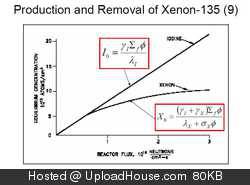
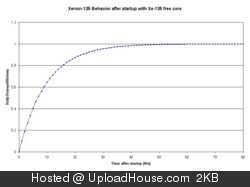
•Production and Removal of Xenon-135
•Xenon-135 Response to Reactor Power Changes and Shutdown
•Xenon-135 Oscillations
•Production and Removal of Samarium-149
•Samarium-149Response to Reactor Shutdown
•Other Neoutron Poisons

Fixed Burnable Poisons (part 1)

•During operation of a reactor the amount of fuel contained in the core constantly decreases

•If the reactor is to operate during long periods, fuel in excess of that needed for exact criticality must be added

•The positive reactivity due to the excess fuel must be balanced with negative reactivity from neutron-absorbing material

Fixed Burnable Poisons (part 2)

•Moveable control rods containing neutron-absorbing materials are one method used to offset the excess fuel

•However, using control rods alone may be impractical

–E.g. there is physically insufficient room for the control rods and their large mechanisms

•To control large amounts of excess fuel burnable poisons are used

•Burnable poisonsare materials that have a high neutron absorption cross section that are converted into materials of relatively low absorption cross section as a result of neutron absorption

Fixed Burnable Poisons (part 3)

•Due to the burnupof the poison material, the negative reactivity of the poison decreases over core life

•Ideally, these poisons should decrease their negative reactivity at the same rate the fuel’s excess positive reactivity is depleted

•Fixed burnable poisons are usually used in the form of compounds of boron or gadolinium that are shaped into separate lattice pins or plates, or introduced as additives to the fuel

Soluble Poisons (part 4)

•Soluble poisons,also called chemical shim,produce as patially uniform neutron absorption when dissolvedin the watercoolant

•The most common soluble poisonin PWR sisboric acid (”soluble boron”or ”solbor”)

•The boric acidin thecoolant decreasesthethermal utilization factor,causingthedecreaseinreactivity

Soluble Poisons (part 5)

•By varying the concentration of boric acidin the coolant (a process referred to asboration and dilution) there activity of the core can be easily varied

•If the boron concentration is increased (boration), the coolant/ moderator absorbs more neutrons,adding negative reactivity

•If the boron concentration is reduced (dilution), positive reactivity is added

Monday, October 4, 2010

The EPR and PWR Reactor Construction

The EPR Reactor construction


The PWR Reactor Constuction

Neutron Poissons (Part#3)

Point of view and understanding regarding Neutron poisons

Image Hosted by UploadHouse.com

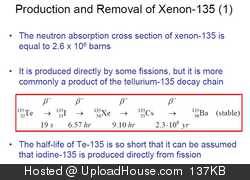
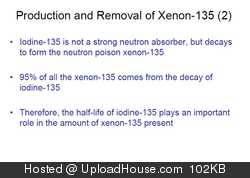
Xe-135 has such a large neutron cross-section that the vast majority of Xenon-135 atoms will never decay in a reactor – they absorb a neutron and become stable Xe-136 before they get a chance to decay.

One can think of Xe-135 as being equivalent to negative one neutrons, because each atom of Xe-135 is likely to absorb a neutron. It’s fission yield is about 6.3% So one way of looking at it is that at equilibrium operation, 6.3% of fission reactions will result in one less neutron.

It’s a fairly large hit on neutron economy, but not a deal-breaker. You can still have a reactor with plenty of neutron economy even with Xe-135. The place that it makes the big difference is stability. The fact that Xenon-135 decays and that it absorbs neutrons as it is irradiated means that when a reactor is shut down or brought to low power, it can be very unstable and the characteristics change as Xe-135 decays. For this reason, when a reactor is shut down it may be necessary to wait for the Xe-135 to decay away before restarting.

There is a cost to removing this stuff. If you leave it in, the vast majority will absorb a neutron and become Xe-136, which is not really a concern of any kind. If removed it will instead decay and it decays to Cs-135.

Removing the Xenon-135 can just about double the yield of Cs-135 from a reactor. Many find that very objectionable because Cs-135 is a long lived radioactive nucleotide.


But Cs-135 is only mildly radioactive, going through a single beta decay to Ba-135 with a half-life of 2.6 million years. Yes some people will worry about it but people will worry about all manner of things that aren’t worth worrying about. I think this is one of those cases.

Back-of-envelope estimate for the time available to extract the Sm-149, for anyone else thinking about this:-

A 1000 MW thermal neutron LFTR power plant requires an inventory of about 1000 kg of U-233 to run, and ‘burns’ about the same quantity per year. An individual U-233 atom in such a reactor therefore has a chance of about 1/365 per day of being hit by a neutron and fissioned.

The thermal neutron fission cross section of U-233 is 530 barns, the absorption cross-section of Sm-149 is about 40,000 barns, about 75 times greater (figures are from JENDL). Therefore the chance of a Sm-149 atom in the above reactor absorbing a neutron is about 75/365 per day or about 1/5. So to halve the loss of neutrons to samarium, you have got to process all the core salt – probably about 20 cubic metres – in five days. Around 170 litres/hr, just under 2 oz/sec

It is suppose it would be valuable to take all the lanthanides out, if such a thing could be done relatively simply. Way back when, ORNL looked at overloading the salt with cerium trifluoride, then cooling the salt and causing the lanthanides to preferentially freeze first, and skim them off. Cerium has a much smaller neutron absorption cross section than the other lanthanides like samarium, europium, and neodymium.

I never really liked that approach much because it seemed like you were cramming the salt full of something you’d rather not anyway. If an electrolytic cell could remove lanthanides online, all the better.

Many of the lanthanides reach nuclear stability quite quickly, but they’re still significant neutron poisons. Samarium-149 is the best example of this.

p/s: in the class, we will cover the Xe-135 and Cs-135

Neutron Poissons (Part#2)

In nuclear reactor design, we describe the cross-section of different nuclides in a unit called a “barn”. It has units of area. So what does that mean?

Image Hosted by UploadHouse.com


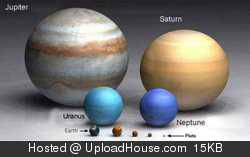
Well, take a look at this picture. This shows five important nuclides plotted against each other, with their size determined by their “barns”. You can see that one of them is absolutely HUGE.
That is xenon-135, as far as I know, the nuclide with the largest cross-section to absorb thermal neutrons.
Next on the list of trouble is samarium-149, which is really big, but not nearly as big as xenon-135. Again, to the best of my knowledge, samarium-149 is number #2 on the list of trouble.
For comparison purposes, I show the relative cross-sections of three fissile nuclides, uranium-233, uranium-235, and plutonium-239. These three are fuel in a nuclear reactor, and the bigger these are the better when it comes to making reactors small. By most descriptions of cross-section, U-233, U-235, and Pu-239 have big cross-sections, but you can see that they’re pretty small compared to Xe-135 and Sm-149. Like comparing the inner planets to Jupiter and Uranus.

Image Hosted by UploadHouse.com

Why does this matter? Because if we had it our way, we wouldn’t want any Xe-135 or Sm-149 gobbling up neutrons in our reactor. Neutrons they eat are neutrons that we can’t use to make energy by splitting fissile nuclides like Pu-239 or U-233.
Xe-135 has two major differences from Sm-149. The first is that it is radioactive. It goes away if you leave it for awhile. It has a half-life of about nine hours. Sm-149 doesn’t go away. It is not radioactive. It is stable.
The other difference is that xenon is a noble gas, and is easy to remove from a fluid fuel like the salts that we want to use in liquid-fluoride reactors. So getting Xe-135 out of the mix isn’t terribly difficult. Samarium on the other hand is pretty challenging to extract from the salt mixture. It’s one of a family of elements called the “lanthanides“, and they all have very similar chemical properties to each other, because their outermost electron layer (the one that does all the chemical bonding) is the same while they fill up the inner electron layers as you progress up the list of lanthanides. So it’s hard to come up with a chemical process that is particularly good at picking off samarium without picking off all of the other lanthanides at the same time.

Neutron Poissons (Part#1)

The important information in this chapter is summarized below.Neutron Poisons SummaryA burnable neutron poison is a material that has a high neutron absorption crosssection that is converted into a material of relatively low absorption cross sectionas the result of neutron absorption.

A non-burnable neutron poison is a material that has relatively constant neutronabsorption characteristics over core life. The absorption of a neutron by one isotopein the material produces another isotope that also has a high absorption crosssection.Chemical shim is a soluble neutron poison that is circulated in the coolant duringnormal operation.

Burnable neutron poisons are used in reactor cores to compensate for the excesspositive reactivity of the fuel when the reactor is initially started up.Chemical shim has several advantages over fixed burnable poisons.
Has a spatially uniform effectPossible to increase or decrease amount of poison in the core duringreactor operationFixed burnable poisons have several advantages over chemical shim.

Can be used to shape flux profilesDo not have an adverse effect on moderator temperature coefficientTwo reasons for using non-burnable neutron poisons in reactor cores are to shape powerand to prevent excessive flux and power peaking near moderator regions.An example of a material that is used as a fixed non-burnable neutron poison is hafnium.

Did You Know (Disposal Facilities)


Dumpsite danger


It has been 28 years but the people of Bukit Merah and Papan have not forgotten. Triggered by Tun Dr Mahathir Mohamad’s recent comments about the radioactive waste in Perak, The Star has unearthed some new developments there.

FOR almost 30 years, the country’s cache of dangerous radioactive waste has been stored in drums in a concrete facility – and not buried “deep in the ground” as claimed by Tun Dr Mahathir Mohamad.

The former prime minister, commenting on the Government’s proposal to build a nuclear power plant, told a press conference on May 14 that there was ‘’a small amount’’ of nuclear waste buried in Perak and that the disposal site was still regarded unsafe.

‘’In Malaysia, we do have nuclear waste which perhaps the public is not aware of. We had to bury the amang, a by-product from tin mining.

Area of concern: An aerial view of the dumpsite at the Kledang Range. On the lower left is Engineered Cell 1 where all materials from the decommissioned ARE factory are buried. Beside it is the concrete facility where the drums with thorium hydroxide are kept.

‘’It is not radioactive but it is not good to handle. We had to bury it in Perak, deep in the ground. But the place is still not safe, and we have almost one square mile that is dangerous,” he said, adding that he did not know where the site was.

Following his remarks, The Star has discovered that 80,000 200-litre drums containing radioactive waste are currently being kept at the dump located in the Kledang Range behind Papan town. The site is about 3km from Bukit Merah and Papan and about 15km from Ipoh. And the waste is thorium hydroxide, not amang.

In fact, it is only January this year that work finally began on the building of a proper underground storage facility called an engineered cell (EC).

For the residents of Bukit Merah and Papan, Dr Mahathir’s acknowledgement of the danger comes as a bitter vindication of their long-drawn battle to stop Asian Rare Earth Sdn Bhd (ARE), a company located at the Bukit Merah Industrial Area in the 1980s, from disposing of its radioactive waste near their towns.

And if the rest of the country has forgotten what they went through 27 years ago, the people of Bukit Merah, Papan and other settlements have not.

Perak Anti-Radioactive Committee chair man Hew Yoon Tat took Dr Mahathir to task for seemingly making light of the matter.

“The waste was never buried and the amount is not small. I would also like to remind Dr Mahathir that the radioactive waste came from a company approved by the Government to process rare earth,” he said.

Hew, 66, a butcher from Bukit Merah, added that the ARE factory extracted yytrium from monazite, one of the minerals found in amang (tin tailings), which were exported for use in high technology products.

In the production process, thorium hydroxide was produced. Both monazite and the waste contained thorium, which has a half-life of 13.9 billion years.

“Cancer-causing radon gas is released during decay,” he added.

ARE, which started production in 1982, had constructed the facility in the Kledang Range after former Deputy Prime Minister Tun Musa Hitam declared a proposed dumpsite on a durian hill near settlements in Papan unsafe and ordered the company to look for an alternative site.

Countering Dr Mahathir’s statement that “perhaps the public is not aware” of the waste, Hew said: “People involved in the series of protests, court case, and those whose lives were affected by ARE will never forget.

“These are the people who had suffered illnesses, braved clashes with the police during demonstrations, were arrested under the Internal Security Act, spent time away from work to show support during protests in Papan, Bukit Merah, Kuala Lumpur, and even in Tokyo.”

Hew was arrested under the Internal Security Act during Operation Lalang in 1987.

Papan-Pusing-Siputeh Anti-Radioacative Waste Dump committee chairman Low Tong Hooi, 69, is also astounded by Dr Mahathir’s statements.

“Why is it only now that he has admitted the radioactive dump is dangerous? In 1984, he maintained that the poorly constructed trenches for the waste in Papan in 1984 were safe,” he said.

Low added that experts from America, Britain, Canada and Japan brought in with the help of Sahabat Alam Malaysia, Consumer Associa­tion of Penang and the Environmental Protec tion Society of Malaysia declared the factory and the dump unsafe but the Government preferred to heed another view.

Although the ARE factory ceased operations in 1994, the company still maintains an office in a Menglembu housing estate.

The Star has learnt that it was only nine years later, between 2003 and 2005, that a decommissioning and decontamination exercise was carried out at the factory.

ARE’s general manager (administration) Kazuhiko Nishikawa said that about 250,000 tonnes of contaminated equipment, concrete structure, soil and materials were removed and transported by specially designed lorries approved by the Atomic Energy Licensing Board to an engineered cell called EC1 constructed at the 41ha site in the Kledang Range at the back of Papan.

“AELB has confirmed that the former factory site has been fully cleaned and is free from radioactive contamination. The lot was returned to the state government last year,” he said in an interview.

Kazuhiko said the company was now carrying out a project to construct another engineered cell (EC2) next to EC1 to store the thorium hydroxide accumulated during ARE’s operations between May 1982 and July 1984. The EC2 will decommission the use of the present storage facility and dispose of everything underground to a depth of 10m, similar to EC1.

Details of the project took three years to be worked out and had been reviewed by local and international experts and approved by AELB, he said.

“The project was designed in accordance with international and Malaysian standards and regulations set by agencies such as the International Commission on Radiological Protection, the International Atomic Energy Agency, AELB and the Department of Occupa tional Safety and Health.

“It is also being monitored by the Perak Government and its consultant is the Malay sian Nuclear Agency,” he said.

Kazuhiko said 500,000 tonnes of contaminated materials comprising debris from the concrete facility which would be demolished, 80,000 drums of wastes, and soil would be sent to EC2.

ARE has tasked US-based environmental and geotechnical engineering design and construction services specialist GeoSyntec Consultants Inc and its Malaysian subsidiary, GSM Consultancy (M) Sdn Bhd, with the management and implementation of the project.

Work of the project commenced in January. AELB would supervise and inspect all works during construction and the Perak government, relevant state agencies, and the PARC would be briefed on its progress, said Kazuhiko.

GSM Consultancy (M) Sdn Bhd director Anthony Goh said EC1 had been properly designed and constructed, based on its monitoring over the past six years.

Goh said frequent monitoring at the site had been carried out since 1992 and the results reported to the AELB.

“We did not find any increase in the background level of radiation and radon gas. Tests on ground and surface water and vegetation in the area did not suggest any contamination,” said Goh.

He added that all those involved in EC2, scheduled for completion in 2013, would be given a dosimeter badge to check on contamination and would undergo medical check-ups every month.

“Mechanised handling of the drums and waste will be introduced when transferring into EC2. We will solidify and repack the waste if the drums are corroded,” he said.

He also said the operation did not pose any public risk as there was no one living within 2km from the site.

“The dump will have a 200m buffer zone from its fence where no human activities would be allowed,” he added.

Both the engineered cells would then be “capped” with a final single cover to ensure safe disposal and minimal impact to the environment, he added.

AELB will monitor the site for two years before it is handed to the state government for long-term management and maintenance to ensure security.

Kazuhiko added that ARE was bearing the cost for the project but declined to reveal the amount.

PARC’s Hew said no one could ensure that the dump would not pose any danger in the long run. He hoped that future state governments would not forget about the dump and would continue to monitor it for the sake of the people.


credit to --->>>BY FOONG THIM LENG

sunday@thestar.com.my


p/s:

waste management,should be handled by experts such as AELB and some other company under supervising of MOSTI and MNA.

Did You Know (Kronologi Asian Rare Earth Di Bukit Merah,Ipoh,Perak)

Berikut adalah kronologi penetangan Asian Rare Earth (ARE) di Bukit Merah, Ipoh sehingga penutupannya pada 19 Januari, 1994.

Anda rakyat prihatin. Selamatkan generasi masa depan kita. Bersuaralah dan hentikan pemprosesan ‘rare earth’ di Kuantan sebelum terlambat.

1979

November: Syarikat Asian Rare Earth (ARE) dibentuk untuk mengekstrak itrium ( sejenis unsur nadir bumi) daripada monazit. Pemegang saham utamanya ialah Mitsubishi Chemical Industries Ltd (35%), Beh Minerals (35%), Lembaga Urusan dan Tabung Haji (20%) dan beberapa peniaga bumiputera (10%). Pihak ARE telah mendapatkan pandangan dari Pusat Penyelidikan Atom Tun Dr. Ismail (Puspati), Kementerian Sains, Teknologi dan Alam Sekitar mengenai sisa buangan radioaktif yang dihasilkan melalui pemerosesan monazit. Adalah diputuskan, sisa buangan itu yang menjadi milik kerajaan Negeri Perak akan disimpan kerana berpotensi sebagai sumber tenaga nuklear.

1982

Jun: Penduduk Parit, Perak mendapat tahu kerajaan telah memilih kawasan seluas sembilan ekar, kira-kira 6 km dari penempatan mereka untuk dijadikan tapak penimbunan sisa radioaktif syarikat ARE.

30 Jun: Ekoran bantahan hebat daripada jawatankuasa penduduk serta lain-lain pertubuhan politik dan sosial, kerajaan membatalkan cadangan itu dan kemudian mula mencari tapak baru.

11 Julai: Kilang ARE mula beroperasi di KM 7.2, Jalan Lahat di Bukit Merah.

1983

November: Penduduk Papan (kira-kira 16 km dari Ipoh) mendapat tahu ARE sedang mengorek lubang berhampiran tempat kediaman mereka untuk dijadikan tapak buangan sisa radioaktif. Tapak itu merupakan pilihan kerajaan

1984

24 Mei: Kira-kira 6,700 penduduk Papan dan pekan-pekan yang berhampiran menandatangani satu surat bantahan dan menghantarnya kepada Perdana Menteri, Menteri Besar Perak, Menteri Kesihatan serta Menteri Sains, Teknologi dan Alam Sekitar.

31 Mei: Seramai 200 penduduk Papan membantah tapak pembuangan yang dicadangkan. Mereka menyekat jalan yang menuju ke tapak itu.

5 Jun: Perdana Menteri berkata, kerajaan telah mengambil segala langkah berjaga-jaga untuk memastikan keselamatannya dan menegaskan pembinaan tapak buangan radioaktif di Papan akan diteruskan.

18 Jun: Kira-kira 300 penduduk Papan sekali lagi mengadakan tunjuk perasaan sebagai membantah tapak buangan yang dicadangkan.

28 Jun: Menteri Sain, Teknologi dan Alam Sekitar, Datuk Amar Stephen Yong berkata, tapak buangan Papan adalah selamat kerana dibina mengikut piawaian yang ketat. Beliau mencabar pengkritik supaya membuktikan tapak itu boleh mengancam kesihatan dan alam sekitar. Sementara itu, ARE meneruskan operasinya dengan menimbun sisa torium di sebuah kawasan terbuka dan kolam berhampiran kilang itu.

1 Julai: Kira-kira 3,000 penduduk termasuk wanita dan kanak-kanak mengadakan tunjuk perasaan secara aman sebagai membantah tapak buangan tersebut.

4 Julai: Seramai 2,000 orang penduduk terus mengadakan tunjuk perasaan meskipun Ketua Polis Perak memberi arahan supaya bersurai.

18 Julai: Pembentukan Jawatankuasa Bertindak Bukit Merah, terdiri daripada penduduk Bukit Merah, Lahat, Menglembu dan Taman Badri Shah, sebagai tanda sokongan kepada penduduk Papan. Sahabat Alam Malaysia (SAM) menghantar satu memorandum kepada Perdana Menteri memaklumkan paras radiasi yang tinggi telah dikesan dikawasan kolam terbuka berhampiran kilang ARE di Bukit Merah. Satu bacaan yang dicatat oleh pegawai-pegawai SAM sewaktu berkunjung ke situ ialah 43,800 milirem/tahun. Paras ini melebihi 88 kali paras maksimum yang ditetapkan oleh Suruhanjaya Antarabangsa bagi Perlindungan Radiologi (ICRP) untuk orang ramai.

29 Ogos: Michael O ‘Riordan dari Lembaga Perlindungan Radiologi Kebangsaan British dijemput oleh kerajaan untuk memeriksa tapak buangan toksik di Papan.

19 September: Sekumpulan tiga orang dari Agensi Tenaga Atom Antarabangsa (IAEA) Pertubuhan Bangsa-bangsa Bersatu mengunjugi tapak buangan di Papan atas jemputan kerajaan Malaysia. Mereka mengisytiharkan tapak buangan itu tidak selamat.

5 Oktober: Dr William Cannell, seorang ahli fizik dan penganalisis kesihatan menerima jemputan penduduk Papan untuk melawat tapak buangan tersebut. Hasil pemerhatian beliau mendapati kerja-kerja kejuruteraan yang dijalankan oleh syarikat terbabit sangat buruk.

21 Oktober: Seorang pakar dari Amerika dan bekas ahli jawatankuasa Akademi Sains Kebangsaan Amerika bagi kesan-kesan Biologi Radiasi Mengion (BEIR), Dr Edward Radford, atas jemputan penduduk Papan, membuat tinjauan di tapak buangan sisa itu. Beliau dapati tapak itu tidak sesuai sementara lubang-lubang yang digali mempunyai dinding yang nipis atau sudah merekah.

7 November: Seorang pakar buangan sisa industri dari Jepun, Dr. Jun Ui, menerima jemputan penduduk Papan untuk memeriksa tapak buangan ARE. Beliau juga mendapati tapak itu tidak sesuai dijadikan kawasan penimbunan sisa berbahaya.

28 November: Kabinet membincangkan laporan-laporan yang diserahkan oleh dua badan kawalan. Laporan yang dikemukan oleh Lembaga Perlindungan Radiologi Kebangsaan British (NRPB) berkata, penduduk hanya akan selamat jika faktor-faktor tertentu diberi perhatian oleh kerajaan Perak dan syarikat ARE. Laporan kedua oleh IAEA pula berkata, lubang-lubang yang dibina tidak memenuhi syarat-syarat yang ditetapkan.

9 Disember: Lebih 1,500 penduduk di Papan mengadakan mogok lapar selama sehari sebagai membantah keputusan kerajaan untuk meneruskan rancangan menempatkan tapak buangan sisa di Papan. Penduduk Bukit Merah membawa masuk seorang pakar radiasi dan genetik dari Jepun, Profesor Sadao Ichikawa untuk mengukur paras radiasi di kawasan terbuka dan kolam berhampiran kilang ARE. Beliau dapati paras radiasi di situ terlalu tinggi malah paras tertinggi yang dicatatkan melebihi 800 kali paras yang dibenarkan.

12 Disember: Timbalan Perdana Menteri, Datuk Musa Hitam menunjukkan minat secara peribadi terhadap perkembangan isu Papan ini. Beliau mengunjungi tapak buangan tersebut.

1985

11 Januari: Selepas mesyuarat kabinet yang dipengerusikan oleh Timbalan Perdana Menteri ketika itu, Datuk Musa Hitam, kerajaan mengambil keputusan memindahkan tapak buangan sisa ke Mukim Belanja di Banjaran Kledang yang terletak kira-kira 5 km dari Papan dan 3 km dari Menglembu.

1 Februari: Lapan orang penduduk, bagi pihak diri mereka sendiri dan penduduk Bukit Merah membuat satu permohonan di Mahkamah Tinggi Ipoh menahan ARE daripada mengeluar, menyimpan atau menimbun sisa radioaktif di sekitar kampung tersebut.
Akta Perlesenan Tenaga Atom 1984 dikuatkuasakan. Ia memastikan pengendali bahagian pemasangan nuklear (termasuk kerajaan) bertanggungjawab terhadap ancaman nuklear. Lima ahli Lembaga Perlesenan Tenaga Atom (AELB) dibentuk di bawah Akta itu, dengan perwakilan dari Puspati, Kementerian Kesihatan serta Kementerian Sains, Teknologi dan Alam Sekitar.

14 Oktober: Hakim Anuar Datuk Zainal Abidin di Mahkamah Tinggi Ipoh memberikan kepada penduduk Bukit Merah perintah menahan dan menghentikan ARE daripada mengeluar dan menimbun bahan sisa radioaktif sehingga langkah-langkah keselamatan yang secukupnya diambil. Lebih daripada 1,500 penduduk Bukit Merah hadir di mahkamah untuk mendengar keputusan itu.

1986

22 September: ARE mendakwa ia telah membelanjakan lebih RM2 juta untuk meningkatkan langkah-langkah keselamatan (sepertimana yang dikehendaki oleh perintah mahkamah), diikuti oleh piawaian IAEA. Ia menjemput pakar tenaga atom dari Amerika, Dr E.E. Fowler (Bekas kakitangan IAEA) untuk mengunjungi kilang berkenaan. Menurut beliau, paras radiasi berhampiran kawasan pembuangan yang disediakan oleh ARE memenuhi piawaian ICRP dan beliau dapati kilang itu selamat untuk beroperasi.

5 Oktober: Kira-kira 3,000 penduduk Bukit Merah dan kawasan sekitarnya mengadakan tunjuk perasaan terhadap rancangan ARE untuk menimbun sisa radioaktif di tapak kekalnya di Banjaran Kledang.

28 Oktober: Profesor Sadao Ichikawa dalam kunjungan kali keduanya ke Bukit Merah mendapati paras radiasi di sekitar kilang ARE masih melebihi paras yang dibenarkan. Beliau dilarang masuk ke dalam kilang itu.

16 November: Sekumpulan penyiasat dari AELB memeriksa beberapa buah tapak buangan sisa torium yang dilonggokkan secara haram di Bukit Merah. Mereka dibantu oleh bekas kontraktor ARE, Ng Toong Foo yang pernah membuang sisa di situ. Bacaan di salah sebuah tapak ialah 0.05 – 0.10 milirem/jam (iaitu 438 - 876 milirem/tahun) melebihi paras keselamatan maksimum 0.057 milirem/jam yang ditetapkan oleh ICRP.

26 November: Perwakilan dari tujuh kawasan (Bukit Merah, Lahat, Taman Badri Shah, Menglembu, Papan, Falim dan Guntong) membentuk sebuah jawatankuasa Anti-Radioaktif Perak (PARC).

8 Disember: Menteri di Jabatan Perdana Menteri, Encik Kasitah Gadam berkata hasil pemeriksaan AELB di dua tapak buangan haram Bukit Merah mendapati paras radiasi di situ adalah selamat. Menurutnya, sungguhpun AELB mendapati paras radiasi di situ melebihi paras normal, ini tidak membahayakan kerana tapak-tapak itu sangat sedikit bilangannya.

1987

6 Februari: Tanpa mempedulikan perintah Mahkamah Tinggi Ipoh kepada ARE supaya menghentikan operasi, AELB Malaysia memberikan lesen kepada ARE supaya meneruskan operasinya.

10 April: PARC menjemput 14 pakar asing untuk datang ke Bukit Merah-pengasas-pengasas Institut Antarabangsa bagi Kepentingan Awam di Kanada, Dr Rosalie Bertell; Setiausaha Pusat Keselamatan Industri dan Kepentingan Alam Sekitar di India, V.T. Pathmanaban; dan Presiden Institut Kesihatan dan Tenaga di Amerika Syarikat, Kathleen Tucker merupakan antara mereka yang dilarang memasuki kawasan ARE. Dalam satu forum yang berlangsung di Bukit Merah, pakar-pakar itu membuat kesimpulan bahawa ARE mendedahkan pelbagai ancaman kesihatan yang serius.

12 April: Kira-kira 10,000 orang penduduk berarak di Bukit Merah sebagai membantah operasi yang dijalankan semula oleh ARE.

24 Mei: Kira-kira 300 orang penduduk diperintahkan bersurai oleh anggota Unit Simpanan Persekutuan (FRU) berhampiran ARE. Lebih 20 orang, termasuk tiga wanita mengalami kecederaan dalam dua pertelingkahan pada hari itu. Seramai 60 orang ditahan oleh pihak polis. Semua kecuali enam dibebaskan kemudian selepas disoal-siasat. Keenam-enam pemuda itu dibebaskan seminggu kemudian di mana pihak polis tidak mengenakan sebarang tuduhan. Penduduk menghalang kerja-kerja membina jalan yang menuju ke tapak buangan kekal di Banjaran Kledang yang dicadangkan.

23 Julai: Seorang doktor Kanada, Bernie Lau, diupah oleh PARC untuk meletakkan alat pengesan gas radon di luar kilang ARE. Beliau berjaya mengesan sejumlah gas radon dibebaskan daripada kilang itu.
Terdahulu dari itu, Menteri Sains, Teknologi dan Alam Sekitar Datuk Amar Stephen Yong berkata, kerajaan berpuas hati dengan laporan penilaian kesan alam sekitar bagi tapak buangan kekal yang dicadangkan itu. Penilaian itu dijalankan oleh ARE bersama beberapa orang pegawai Kementerian.

7 September: Perbicaraan saman yang dikemukakan oleh lapan orang penduduk Bukit Merah terhadap ARE bermula di hadapan Hakim Peh Swee Chin di Mahkamah Tinggi Ipoh. Sebagai mengetengahkan nasib mereka, para penyokong PARC berjalan sejauh 8 km dari Bukit Merah ke Ipoh. Polis menyuraikan tunjuk perasaan mereka berhampiran Menglembu. Sembilan orang ditahan tetapi dibebaskan setelah diikat jamin. Kira-kira 1,000 orang hadir di mahkamah sebagai menunjukkan sokongan mereka.

11 September: Para penduduk berarak dari Bukit Merah ke Mahkamah Tinggi Ipoh pada hari terakhir perbicaraan. Jumlah mereka yang hadir dianggarkan 3,000 orang.

18 Spetember: Penduduk Bukit Merah mengemukakan permohonan perbicaraan kerana menghina mahkamah terhadap ARE memandangkan ia melanggar perintah menahan operasi yang diberikan oleh Mahkamah Tinggi Ipoh kepada mereka pada tahun 1985.

27 Oktober: Lebih 100 orang yang ditahan di bawah Akta Keselamatan Dalam Negeri (ISA). Di antaranya termasuklah pengerusi PARC, Hew Yoon Tat; timbalannya, Hiew Yew Lan; (bekas) setiausaha PARC, Lee Koon Bun; ahli jawatankuasa, Phang Kooi Yau dan peguam Pengguna Pulau Pinang (CAP) yang mewakili plaintif Bukit Merah, Meenakshi Raman. Merek dibebaskan selepas dua bulan.

November: ARE mula membina tapak buangan kekal sisa toksik di Banjaran Kledang.


1988

25 Januari: Perbicaraan disambung semula.


1990

13 Februari: Perbicaraan tamat selepas berlansung selama 65 hari dan berlanjutan lebih 32 bulan.


1992

11 Julai: Penduduk Bukit Merah memenangi kes saman terhadap ARE. Mahkamah mengarahkan penutupan kilang ARE dalam tempoh 14 hari. Pihak ARE pula mengumumkan ia akan membuat rayuan di Mahkamah Agung.

23 Julai: ARE mengemukan rayuan di Mahkamah Agung berhubung perintah Mahkamah Tinggi Ipoh supaya operasinya dihentikan. Pengerusi PARC Hew Yoon Tat dan salah seorang plaintif dalam saman terhadap ARE, Lau Fong Fatt menemui kakitangan atasan Mitsubishi Chemical di Jepun. Mereka diberitahu ARE mengemukan rayuan tanpa kebenaran syarikat itu.

24 Julai: Berikutan permohonan ex-parte oleh ARE, Hakim Besar Mahkamah Agung menahan (sehingga perintah selanjutnya) perintah Mahkamah Tinggi Ipoh kepada ARE supaya menghentikan operasinya.


3 Ogos: Lebih 2,000 orang dari Bukit Merah hadir di Mahkamah Agung untuk mendengar rayuan ARE terhadap perintah Mahkamah Tinggi Ipoh yang menggantung operasinya. Bagaimanapun, hakim-hakim Mahkamah Agung Menangguhkan perbicaraan kepada 5 Ogos kerana ‘tekanan oleh mereka yang berpiket di luar mahkamah.’

5 Ogos: Mahkamah Agung membenarkan permohonan ARE untuk menolak perintah Mahkamah Tinggi yang meminta ARE menghentikan operasinya berikutan rayuan syarikat berkenaan. Menurut hakim-hakim itu, penutupan tersebut akan menyulitkan kilang dan 183 pekerjanya.


1993

15 Mac: Perbicaraan rayuan yang dikemukan oleh ARE di Mahkamah Agung ditangguhkan pada 7 Jun.

7 Jun: Perbicaraan mendengar rayuan ARE sekali lagi ditangguhkan ke satu tarikh yang akan diberitahu kelak.


1994

19 Januari: Pengumuman syarikat ARE untuk menghentikan operasi.


p/s :


moral of the day :


if malaysia want to set up nuclear power plant by the end of 2021,then we should get clearly understand the important of this matter first rather than building / construction the NPP itself.


otherwise, we will end up with environmental and political issues. waste management is the most crucial issues to be highlighted when dealing with radioactive waste.IMHO, i do support AELB and MNA that they can handle with the radioactive waste properly.

Did You Know (Waste Management)

Do you ever know that residents at Bukit Merah have been exposed to radioactive waste..
I just knew it...
I feel sorry for them...
here some of the story....
taken from internet....for EHS actually...


The story started in 1979; Mitsubishi Chemical, or Mitsubishi Kasei, set up a joint venture company with a Malaysian company BEH Minerals and Lembaga Urusan dan Tabung Haji called Asian Rare Earth (ARE) in Malaysia. The Japanese company has been attracted to Malaysia by a series of facilities and incentives offered by the Malaysian government to the foreign companies to invest in Malaysia.

Asia Rare Earth's purpose was to extract rare-earth from monazite in the town of Bukit Merah (Lake Town), in the state of Perak, which used to be a tin mining and farming area before. Rare-earth elements are incorporated into many modern technological devices, including superconductors, miniaturized magnets, electronic polishers, refining catalysts and hybrid car components. Based on the chemical and technical course of action in extracting rare-earth; this process results in generating radioactive wastes which has been agreed to be possessed by the Perak State Government in 1982. The Perak government selected a site at Parit as the storage dump for the radioactive waste.

A survey which has been made by SAM in 1982 shocked the nation where based on the survey's results; there were no facilities for dumping the radioactive wastes and the local authorities had no knowledge of the toxic wastes. These results showed up a gap in the Environmental Quality Regulations in which there was not any specific regulation on dumping or handling such hazardous wastes.

The local parliament member, representative of resident committees and SAM appealed to the government and Sultan of Perak (King of the Perak state) to withdraw the plan, but silence was maintained by the authorities (SAM, 1984). Later the plan in Parit was withdraw, but a new storage site was constructed in Papan. Before the storage site was built, the radioactive waste was store at the temporary open site near the factory at Bukit Merah. Investigation by SAM on the temporary site showed that the highest radiation level was 87.6 times above the permissible level (SAM, 1984). Another visiting scientist, Dr Edward P. Radford, highlighted the concern with airborne exposure radiation to the local residents within one kilometer radius from the factory (SAM, 1984).

Since the operation of ARE in 1982, the health situation of the Bukit Merah's residents has been worsen and regrettably, no environmental impact assessment has been carried out by ARE. Another shocking truth showed itself through the blood examination of the Bukit Merah's Children in 1987 and 1989 where about 39% of them suffered from a triad of mild lymphadenopathy, congestion turbinate and recurrent rhinitis. The situation worsened when two children of 5 and 7, were diagnosed with acute lymphoblastic leukemia in 1989.

The combination of all the above elements resulted in a large demonstration and filling of a complain by the residents of Bukit Merah New Village against the harmful effects ofARE's radioactive waste on Bukit Merah's residents' health to the High Court of Ipoh, Perak, Malaysia. They demanded the termination of the plant's operation, clean-up of the radioactive materials and payment for the damages. The first court case had resulted in ordering ARE to suspend its operation in 1985. However, in 1987, the Atomic Energy Licensing Board (AELB) granted license for ARE to resume its operation despite the legal process which was still undergoing against it.

Local resident in Bukit Merah formed and funded own NGO, the Perak Anti-Radioactivity Committee with the assistance from environmental NGOs including SAM and CAP. With the networking strategies from the NGO network, the issues have been highlighted internationally including Japan. On top of the NGOs network, the coalition also worked closely with media for the publicity of the event.

Based on the importance of the issue and the global publicity for this case; a campaign to stop ARE's operations was started in Japan. In April 1990, Japanese group "Japan, Asia,Africa and Latin America Solidarity Committee" started a signature campaign calling for the shutdown of ARE. This campaign had badly damage the image of Mitsubishi Chemical and even the Japanese government has sent the warning to Mitsubishi.

In 1994, ARE declared its facilities in Bukit Merah to be shut down claiming due to difficulties in obtaining local monazite, and competition from rare earth producers incorporated in foreign countries, especially China. However, there have been a number of assumptions on the reality behind ARE's decision in shutting down its facilities such as the virulence of the local opposition to the factory, saving Mitsubishi's face and/or to secure an award of costs and, the highly negative opinion of the public towards ARE because of the international campaign against it.

The case of ARE is the most renowned environmental battle in Malaysia; nevertheless, there has not been any concrete resolution over it. Asia Rare Earth denounced all accusations due to the lack of conclusive evidences and therefore no compensation has been paid to the Bukit Merah's residents.

Friday, October 1, 2010

Nuclear Power Station ..How it work?

The process how the nuclear reactor produce electricity


The process how the nuclear produce the energy

What if we can’t get nuclear by 2021, what are the impacts?

As we know that, the benefits of using nucleur reactor as to generate electricity is more than using the fuel or some others. But some of the people are afraid when heard about nuclear. They are imaging that nuclear as a bomb which was destroyed the whole Hiroshima and Nagasaki. We sometimes need positive thinking in some condition of thing. If we always be in negative thinking, we will get trouble in the future and we will not get advancement..

Here, I'm list the benefit of using the nuclear reactor.. All of these are data from countries which already using the nuclear reactor actually in USA

Greenhouse Emissions Of Nuclear Power

There is world wide concern over the prospect of Global Warming primarily caused by the emission of Carbon Dioxide gas (CO2) from the burning of fossil fuels.

Although the processes of running a Nuclear Power plant generates no CO2, some CO2 emissions arise from the construction of the plant, the mining of the Uranium, the enrichment of the Uranium, its conversion into Nuclear Fuel, its final disposal and the final plant decommissioning. The amount of CO2

generated by these secondary processes primarily depends on the method used to enrich the Uranium (the gaseous diffusion enrichment process uses about 50 times more electricity than the gaseous centrifuge method) and the source of electricity used for the enrichment process. It has been the subject of some controv

ersy. To estimate the total CO2 emissions from Nuclear Power we take the work of the Swedish Energy Utility, Vattenfall, which produces electricity via Nuclear, Hydro, Coal, Gas, Solar Cell, Peat and Wind energy sources and has produced credited Environment Product Declarations for all these processes.

Vattenfall finds that averaged over the entire lifecycle of their Nuclear Plant including Uranium mining, milling, enrichment, plant construction, operating, decommissioning and waste disposal, the total amount CO2 emitted per KW-Hr of electricity produced is 3.3 grams per KW-Hr of produced power. Vattenfall measures its CO2 output from Natural Gas tobe 400 grams per KW-Hr and

from coal to be 700 grams per KW-Hr. Thus nuclear power generated by Vattenfall, which may constitute World's best practice, emits less than one hundredth the CO2 of Fossil-Fuel based generation. In fact Vattenfall finds its Nuclear Plants to emit less CO2 than any of its other energy production mechanisms including Hydro, Wind, Solar and Biomass although all of these processes emit much less than fossil fuel generation of electricity.

http://nuclearinfo.net

Powering of the economy

Since the oil embargo of 1973, Americans have used energy more wisely and more efficiently. During this time, our population has grown from 211 million to almost 280 million, our economy has grown about 50 percent, but our use of energy has grown only 10 percent. But our economic growth, however, has been fueled largely by electric power.

Between 1973 and 1990, our GDP, which is the measurement of a nation's wealth, grew by about 50 percent. In the same period, electricity use grew by 58 percent. From this information, we can conclude that in order to m

eet the needs of our strong economy and our growing population, we must have reliable supplies of electric power. The nation's nuclear power plants produced 674 billion kilowatt-hours of electricity in 1996. This was m

ore electricity than the entire country consumed in the early 1950s. Worldwide, there are 442 nuclear power plants at work, contributing about 19 percent of the world's electricity supply.


Reduction of dependent on oil

At the time of the 1973 oil embargo, oil accounted for about 17 percent of US. electric supply; nuclear energy was about 5 percent. In 1990, however, oil represented only about 4 percent of U.S. electric supply, while nuclear energy accounted for about 21 percent. Consequently, the U.S. imports 20 million barrels less of oil each year. For example, since l973, nuclear energy has displaced 4.3 billion barrels o

f imported oil and reduced our trade deficit by $12 billion. This decrease in our trade deficit causes a direct increase of our Gross National Product, which is also measure of a nations wealth.


World Wide

More than 400 nuclear power plants are operating in 25 countries around the world today, supplying almost 17 percent of the world's electricity. In most co untries, nuclear energy plays an even larger role as a source of electricity than in the United States. Many of these nations are building new nuclear energy plants to meet the needs of their growing populations and expanding economies. About 83 new nuclear energy plants are currently being built around the world

Conclusion

Overall, nuclear energy has proven to be most beneficial to our society. As a result of this technology, the United States has decreased its dependency on foreign-imported oil. In fact, the United States saves about 12 billion dollars each year through the lack of oil it imports from other nations. Nuclear energy has also proven to be a protector of the environment because of the lack of CO2, greenhouse gasses, and other gases it emits into the atmosphere. There are, however, some major drawbacks to using nuclear energy. These drawbacks include the actual safety of using nuclear energy, the waste it produces, and the atomic weapons that nuclear energy promotes. Overall, however, we believe that the use of nuclear energy greatly outweighs any other source of energy..

So, what we wait for? wait until our life cost become increasing continuously?or wait until our development will get negative effect from the increasing of fuel price? or wait until the global warming become worst? So, everyone can think as good as possible what our country needs.