The Nuclear Fuel Cycle
- The nuclear fuel cycle is the series of industrial processes which involve the production of electricity from uranium in nuclear power reactors.
- Uranium is a relatively common element that is found throughout the world. It is mined in a number of countries and must be processed before it can be used as fuel for a nuclear reactor.
- Fuel removed from a reactor, after it has reached the end of its useful life, can be reprocessed to produce new fuel.
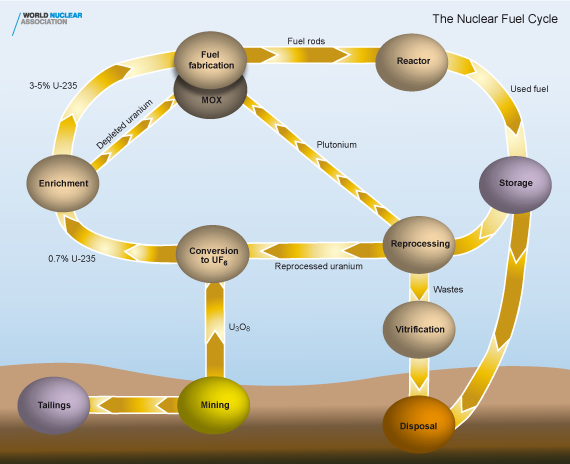
The various activities associated with the production of electricity from nuclear reactions are referred to collectively as the nuclear fuel cycle. The nuclear fuel cycle starts with the mining of uranium and ends with the disposal of nuclear waste. With the reprocessing of used fuel as an option for nuclear energy, the stages form a true cycle.
Uranium
Uranium is a slightly radioactive metal that occurs throughout the Earth's crust (see page on Uranium and Depleted Uranium). It is about 500 times more abundant than gold and about as common as tin. It is present in most rocks and soils as well as in many rivers and in sea water. It is, for example, found in concentrations of about four parts per million (ppm) in granite, which makes up 60% of the Earth's crust. In fertilisers, uranium concentration can be as high as 400 ppm (0.04%), and some coal deposits contain uranium at concentrations greater than 100 ppm (0.01%). Most of the radioactivity associated with uranium in nature is in fact due to other minerals derived from it by radioactive decay processes, and which are left behind in mining and milling.
There are a number of areas around the world where the concentration of uranium in the ground is sufficiently high that extraction of it for use as nuclear fuel is economically feasible. Such concentrations are called ore.
Uranium mining
Both excavation and in situ techniques are used to recover uranium ore. Excavation may be underground and open pit mining.
In general, open pit mining is used where deposits are close to the surface and underground mining is used for deep deposits, typically greater than 120 m deep. Open pit mines require large holes on the surface, larger than the size of the ore deposit, since the walls of the pit must be sloped to prevent collapse. As a result, the quantity of material that must be removed in order to access the ore may be large. Underground mines have relatively small surface disturbance and the quantity of material that must be removed to access the ore is considerably less than in the case of an open pit mine. Special precautions, consisting primarily of increased ventilation, are required in underground mines to protect against airborne radiation exposure.
An increasing proportion of the world's uranium now comes from in situ leach (ISL) mining, where oxygenated groundwater is circulated through a very porous orebody to dissolve the uranium oxide and bring it to the surface. ISL may be with slightly acid or with alkaline solutions to keep the uranium in solution. The uranium oxide is then recovered from the solution as in a conventional mill.
The decision as to which mining method to use for a particular deposit is governed by the nature of the orebody, safety and economic considerations.
For more detailed information see the information pages on:
Uranium milling
Milling, which is generally carried out close to a uranium mine, extracts the uranium from the ore. Most mining facilities include a mill, although where mines are close together, one mill may process the ore from several mines. Milling produces a uranium oxide concentrate which is shipped from the mill. It is sometimes referred to as 'yellowcake' and generally contains more than 80% uranium. The original ore may contain as little as 0.1% uranium, or even less.
In a mill, uranium is extracted from the crushed and ground-up ore by leaching, in which either a strong acid or a strong alkaline solution is used to dissolve the uranium oxide. The uranium oxide is then precipitated and removed from the solution. After drying and usually heating it is packed in 200-litre drums as a concentrate, sometimes referred to as 'yellowcake'.
The remainder of the ore, containing most of the radioactivity and nearly all the rock material, becomes tailings, which are emplaced in engineered facilities near the mine (often in mined out pit). Tailings need to be isolated from the environment because they contain long-lived radioactive materials in low concentrations and toxic materials such as heavy metals; however, the total quantity of radioactive elements is less than in the original ore, and their collective radioactivity will be much shorter-lived.
Conversion and enrichment
The uranium oxide product of a uranium mill is not directly usable as a fuel for a nuclear reactor and additional processing is required. Only 0.7% of natural uranium is 'fissile', or capable of undergoing fission, the process by which energy is produced in a nuclear reactor. The form, or isotope, of uranium which is fissile is the uranium-235 (U-235) isotope. The remainder is uranium-238 (U-238). For most kinds of reactor, the concentration of the fissile uranium-235 isotope needs to be increased – typically to between 3.5% and 5% U-235. This is done by a process known as enrichment, which requires the uranium to be in a gaseous form. The uranium oxide concentrate is therefore first converted to uranium hexafluoride, which is a gas at relatively low temperatures.
At a conversion facility, the uranium oxide is first refined to uranium dioxide, which can be used as the fuel for those types of reactors that do not require enriched uranium. Most is then converted into uranium hexafluoride, ready for the enrichment plant. The main hazard of this stage of the fuel cycle is the use of hydrogen fluoride. The uranium hexafluoride is then drained into 14-tonne cylinders where it solidifies. These strong metal containers are shipped to the enrichment plant.
The enrichment process separates gaseous uranium hexafluoride into two streams, one being enriched to the required level and known as low-enriched uranium; the other stream is progressively depleted in U-235 and is called 'tails', or simply depleted uranium.
There are two enrichment processes in large-scale commercial use, each of which uses uranium hexafluoride gas as feed: diffusion and centrifuge. These processes both use the physical properties of molecules, specifically the 1% mass difference between the two uranium isotopes, to separate them. The last diffusion enrichment plants are likely to be phased out by 2013.
The product of this stage of the nuclear fuel cycle is enriched uranium hexafluoride, which is reconverted to produce enriched uranium oxide. Up to this point the fuel material can be considered fungible (though enrichment levels vary), but fuel fabrication involves very specific design.
Enrichment is covered in detail in the page on Uranium Enrichment.
Fuel fabrication
Reactor fuel is generally in the form of ceramic pellets. These are formed from pressed uranium oxide (UO2) which is sintered (baked) at a high temperature (over 1400°C)a. The pellets are then encased in metal tubes to form fuel rods, which are arranged into a fuel assembly ready for introduction into a reactor. The dimensions of the fuel pellets and other components of the fuel assembly are precisely controlled to ensure consistency in the characteristics of the fuel.
In a fuel fabrication plant great care is taken with the size and shape of processing vessels to avoid criticality (a limited chain reaction releasing radiation). With low-enriched fuel criticality is most unlikely, but in plants handling special fuels for research reactors this is a vital consideration.
Power generation and burn-up
Inside a nuclear reactor the nuclei of U-235 atoms split (fission) and, in the process, release energy. This energy is used to heat water and turn it into steam. The steam is used to drive a turbine connected to a generator which produces electricity. Some of the U-238 in the fuel is turned into plutonium in the reactor core. The main plutonium isotope is also fissile and this yields about one third of the energy in a typical nuclear reactor. The fissioning of uranium (and the plutonium generated in situ) is used as a source of heat in a nuclear power station in the same way that the burning of coal, gas or oil is used as a source of heat in a fossil fuel power plant.
Typically, some 44 million kilowatt-hours of electricity are produced from one tonne of natural uranium. The production of this amount of electrical power from fossil fuels would require the burning of over 20,000 tonnes of black coal or 8.5 million cubic metres of gas.
An issue in operating reactors and hence specifying the fuel for them is fuel burn-up. This is measured in gigawatt-days per tonne and its potential is proportional to the level of enrichment. Hitherto a limiting factor has been the physical robustness of fuel assemblies, and hence burn-up levels of about 40 GWd/t have required only around 4% enrichment. But with better equipment and fuel assemblies, 55 GWd/t is possible (with 5% enrichment), and 70 GWd/t is in sight, though this would require 6% enrichment. The benefit of this is that operation cycles can be longer – around 24 months – and the number of fuel assemblies discharged as used fuel can be reduced by one third. Associated fuel cycle cost is expected to be reduced by about 20%.
As with as a coal-fired power station about two thirds of the heat is dumped, either to a large volume of water (from the sea or large river, heating it a few degrees) or to a relatively smaller volume of water in cooling towers, using evaporative cooling (latent heat of vapourisation).
Used fuel
With time, the concentration of fission fragments and heavy elements formed in the same way as plutonium in the fuel will increase to the point where it is no longer practical to continue to use the fuel. So after 12-24 months the 'spent fuel' is removed from the reactor. The amount of energy that is produced from a fuel bundle varies with the type of reactor and the policy of the reactor operator.
When removed from a reactor, the fuel will be emitting both radiation, principally from the fission fragments, and heat. Used fuel is unloaded into a storage pond immediately adjacent to the reactor to allow the radiation levels to decrease. In the ponds the water shields the radiation and absorbs the heat. Used fuel is held in such pools for several months to several years. It may be transferred to ventilated dry storage on site.
Depending on policies in particular countries, some used fuel may be transferred to central storage facilities. Ultimately, used fuel must either be reprocessed or prepared for permanent disposal.
Reprocessing
Used fuel is about 94% U-238 but it also contains almost 1% U-235 that has not fissioned, almost 1% plutonium and 4.5% fission products, which are highly radioactive, with other transuranic elements formed in the reactor. In a reprocessing facility the used fuel is separated into its three components: uranium, plutonium and waste, which contains fission products. Reprocessing enables recycling of the uranium and plutonium into fresh fuel, and produces a significantly reduced amount of waste (compared with treating all used fuel as waste). See page on Processing of Used Nuclear Fuel.
Uranium and plutonium recycling
The uranium from reprocessing, which typically contains a slightly higher concentration of U-235 than occurs in nature, can be reused as fuel after conversion and enrichment.
The plutonium can be directly made into mixed oxide (MOX) fuel, in which uranium and plutonium oxides are combined. In reactors that use MOX fuel, plutonium substitutes for the U-235 in normal uranium oxide fuel (see page on Mixed Oxide (MOX) Fuel).
Used fuel disposal
At the present time, there are no disposal facilities (as opposed to storage facilities) in operation in which used fuel, not destined for reprocessing, and the waste from reprocessing, can be placed. Although technical issues related to disposal have been addressed, there is currently no pressing technical need to establish such facilities, as the total volume of such wastes is relatively small. Further, the longer it is stored the easier it is to handle, due to the progressive diminution of radioactivity. There is also a reluctance to dispose of used fuel because it represents a significant energy resource which could be reprocessed at a later date to allow recycling of the uranium and plutonium. There is also a proposal to use it in Candu reactors directly as fuel. This proposal, known as DUPIC (direct use of used PWR fuel in Candu reactors) is covered at the end of the page on Processing of Used Nuclear Fuel.
A number of countries are carrying out studies to determine the optimum approach to the disposal of used fuel and wastes from reprocessing. The general consensus favours its placement into deep geological repositories, initially recoverable before being permanently sealed.
Wastes
Wastes from the nuclear fuel cycle are categorised as high-, medium- or low-level wastes by the amount of radiation that they emit. These wastes come from a number of sources and include:
- low-level waste produced at all stages of the fuel cycle;
- intermediate-level waste produced during reactor operation and by reprocessing;
- high-level waste, which is waste containing fission products from reprocessing, and in many countries, the used fuel itself.
The enrichment process leads to the production of much 'depleted' uranium, in which the concentration of U-235 is significantly less than the 0.7% found in nature. Small quantities of this material, which is primarily U-238, are used in applications where high density material is required, including radiation shielding and some is used in the production of MOX fuel. While U-238 is not fissile it is a low specific activity radioactive material and some precautions must, therefore, be taken in its storage or disposal.
See page on Waste Management in the Nuclear Fuel Cycle.
Material balance in the nuclear fuel cycle
The following figures may be regarded as typical for the annual operation of a 1000 MWe nuclear power reactor:b
| Mining | 20,000 tonnes of 1% uranium ore |
|---|---|
| Milling | 230 tonnes of uranium oxide concentrate (which contains 195 tonnes of uranium) |
| Conversion | 288 tonnes uranium hexafluoride, UF6 (with 195 tU) |
| Enrichment | 35 tonnes enriched UF6 (containing 24 t enriched U) – balance is 'tails' |
| Fuel fabrication | 27 tonnes UO2 (with 24 t enriched U) |
| Reactor operation | 8760 million kWh (8.76 TWh) of electricity at full output, hence 22.3 tonnes of natural U per TWh |
| Used fuel | 27 tonnes containing 240 kg transuranics (mainly plutonium), 23 t uranium (0.8% U-235), 1100kg fission products. |
Further information
Notes
a. UO2 has a very high melting point – 2865°C (compared with uranium metal – 1132°C). [Back]
b. Figures are based on the following assumptions: enrichment to 4% U-235 with 0.25% tails assay – hence 140,000 SWU (separative work units) of enrichment needed (one SWU requires about 50kWh of electricity at a gas centrifuge enrichment plant); core load 72 tU, refuelling so that 24 tU/yr is replaced; operation – 45,000 MWday/t (45 GWd/t) burn-up, 33% thermal efficiency. In fact, a 1000 MWe reactor cannot be expected to run at 100% load factor – 90% is more typical, so an output of around 7.75 TWh/yr is more realistic, but this simply means scaling back the inputs accordingly, e.g. to 175.5 tU.
Canadian figures for tU/GWe/yr suggest slightly lower uranium requirements and utilization for PHWRs than for light water reactors. An International Atomic Energy Agency technical report1 gives 157 tU at typical 7.5 GWd/t burn-up and 31% thermal efficiency, or 142 tU at 90% capacity factor, hence 80% of the input compared with a typical LWR above. This is 17.9 tU/TWh.
Considering just how much of the original uranium is actually used: 0.7% fissile U-235 is in natural U (Unat), on above figures 0.49% of Unat goes into fuel as the fissile part, 0.39% is actually fissioned, and in addition about half that much U-238 turned into Pu-239 is fissioned, giving about a 0.6% utilization of the original Unat. [Back]
References
1. Heavy Water Reactors: Status and Projected Development, Technical Reports Series No. 407, International Atomic Energy Agency, 2002, STI/DOC/010/407 (ISBN: 9201115024). PHWR data is taken from Chapter 6, HWR Fuel Cycles [Back]
credit to : www.iaea.org

